

Listed the podcast
Energy increasing demand
People across the globe continue to move to cities, accelerating the demand for housing and transport infrastructure such as railways and electric vehicles charging networks. The annual production of cement has quadrupled from 1 billion to over 4 billion tons since the 1990s, primarily driven by developing countries such as China and India. Over the last 15 years, demand for steel has increased by over 40% and continues to grow, particularly in emerging economies. These are only few examples of reason why the energy demand is increasing.
The greater the demand for energy, the greater the attention must be paid to CO2 emissions into the atmosphere.
The challenge lies not only in meeting this demand, but also in doing so without increasing the climate burden – and, eventually, even reducing it. Introducing circular systems and redesigning products to increase their longevity and efficiency will reduce the demand for raw materials.
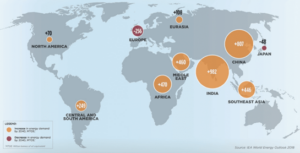
Growth in energy demand: 2017 -2040
The energy-intensive industries (EIIs)
Energy-intensive industries (EIIs) are sectors like steel, chemicals, cement, waste incineration, and pulp that require massive amounts of energy to operate. For historical and economic reasons, these industries have traditionally relied on fossil fuels for energy generation. The central challenge for EIIs is balancing climate-neutrality goals with economic survival. Transitioning to low-emission technologies requires immense capital and access to affordable, green electricity.
Biomass and solid waste generate energy through combustion, gasification, or anaerobic digestion, turning organic matter into electricity and heat. This process—often called waste-to-energy—reduces landfill volume and lowers greenhouse gas emissions.
The use of these resources offers significant advantages, including local energy self-sufficiency, efficient solid waste management, and reduced net carbon dioxide emissions, as they are generally considered carbon-neutral. However, these facilities require advanced flue gas treatment systems to prevent the release of particulate matter and other harmful pollutants into the atmosphere. In addition, they rely on short supply chains to ensure genuine environmental sustainability.
The circular economy
Waste incineration and thermal utilization of wastes for energy production are gaining importance in several countries, mainly because of environmental protection and resource management regulations which aims to promote a higher contribution from renewable energy resources in the production of electricity in the relative domestic markets.
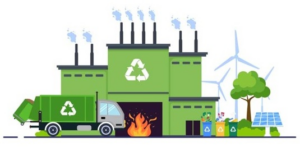
Characterization of solid waste
Renewable energy resources become an alternative to fossil fuels and help to mitigate the issues relevant to environmental sustainability. The use of solid waste generated by manmade activities may be considered as an alternative source of energy which may also contribute to the 50% reduction of CO2 by 2050. Solid waste principally consists of biomass waste, agricultural waste, and municipal solid waste. Waste-derived fuels qualified as Solid Recovered Fuels (SRF) can be used directly in energy conversion processes, such as in incineration, combustion, and pyrolysis, where energy is used for supplying heat and/or electric power. For instance, the cement industry is widely adopting SRF to lower greenhouse gas emissions, preserve natural resources, and promote sustainable waste management practices. Understanding the composition of the organic elements in SRF, particularly Carbon (C), Hydrogen (H), Nitrogen (N), Sulfur (S), and Oxygen (O), is essential for evaluating its combustion efficiency, energy potential, and environmental impact. Carbon, Nitrogen, and Sulfur contents are particularly significant when applying thermal treatments due to the formation of CO2, NOX and SO2, which contribute to the greenhouse effect, acid rain, and photochemical smog. Accurate CHNS analysis begins with proper sample preparation, as the degree of chemical homogeneity significantly affects the reliability of the results.
Not only elemental analysis
Solid waste material typically contains a mix of both biogenic carbon and fossil-derived carbon (e.g., plastics). Because waste-to-energy facilities release large volumes of combined emissions, identifying the exact biogenic fraction is vital for complying with environmental regulations, avoiding carbon taxes, and trading green fuels. It is therefore essential to determine the amount of biogenic CO2 emitted during combustion or to verify the amount of biogenic portion of the solid waste to burn or both.
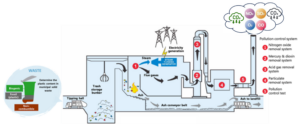
Typical Waste to Energy plantincinerates
The type of process shown above is used by facilities other than incineration plants as well: in other words, alternative fuels, such as solid recovered fuel (SRF), are used not only in incineration plants but also in industrial facilities such as steelworks, cement plants, and other manufacturing plants. All these facilities therefore require the chemical characterization of the materials used for energy generation, including not only elemental analysis but also the determination of their biogenic fraction.
The determination of the biogenic fraction is often carried out not only for assessing CO₂ emissions to the atmosphere but also for to determine the biogenic fraction of the materials used as combustion fuels.
Elemental analysis analytical method for CHNS determination
The analysis is based on high-temperature catalytic combustion technology, which has proved to deliver precise, reliable, and matrix-independent results. The samples are introduced into the combustion reactor via the autosampler after purging with carrier gas. Here, the samples are introduced into the combustion furnace at high temperature around 1000 °C, in the presence of a catalyst and in excess of pure oxygen gas. During combustion, the elemental components of the sample are quantitatively converted into gaseous oxidation products (CO2, H2O, NXO and SO2). The gas stream then reaches the gas chromatographic column, which ensures homogenous and complete separation of all the elements before the final detection by the Thermal Conductivity Detector (TCD), with no requirement for a reference gas. The amount of hydrogen, nitrogen and sulfur can vary in different types of municipal solid waste depending upon the nature and type of media from where the solid waste is generated.
Analytical method for biogenic fraction determination
One of the most accurate ways to study a material’s bio based vs. petroleum based composition is to analyze the carbon in the product. Bio based carbon originating from plants is radioactive, whereas carbon originating from fossils no longer is. The amount of radioactive carbon in the sample can thus be used to determine the amount of biogenic fraction in the material.
The content of radioactive carbon in the organic material can be determined using a dedicated analytical instrument by measuring the 14C carbon isotope in the sample. This method is commonly used to assess the age of organic material, but it can also be used to evaluate how much of the carbon in the material originates from renewable biomass and how much from fossil origin.
By measuring the presence of carbon-14 (or radiocarbon), we can determine the fraction of the sample that is biogenic compared to the fossil fraction. The detection of 14C is really challenging, due to its extremely low concentration in nature: the required sensitivity is of 1 part in 1015. Therefore, the use of a dedicated detector with high sensitivity and accuracy is required to ensure reliable determination. The 14C SCAR (Saturated-absorption CAvity Ring-down) spectrometer is a new and innovative spectrometer for the 14C measure. Since the 14C SCAR requires the sample to be introduced in gaseous form, it must be coupled with a peripheral. The type of peripheral to be connected to the 14C SCAR depends on the nature of the sample to analyse.
1° CASE – SOLID SAMPLE
If the goal is to determine the biogenic fraction of the feed material entering an incinerator, a cement plant, or a steel plant, the Solid Recovered Fuel (SRF) must first be converted into a gaseous form before being introduced into the 14C SCAR detector. The conversion from the solid to the gaseous phase is carried out by an elemental analyzer. To proceed with the analysis, the sample must first be prepared (see the Sample Preparation section) and then loaded into the elemental analyzer. The elemental analyzer is directly interfaced with the 14C SCAR detector. Once the analysis is started, the biogenic fraction of the sample is automatically determined, since the combustion gases generated by the elemental analyzer are directly transferred to the detector for radiocarbon analysis. The main part of the 14C – SCAR is the Fabry – Perot cavity:
✓ the sample gas to measure is introduced into the cavity
✓ a system of high-tech mirrors, on both sides of the cavity, reflects a laser beam
✓ the laser scans the molecule of the sample gas several times; the more the scanning time, the more the accuracy will be (1 hour time analysis is enough to get a good accuracy).
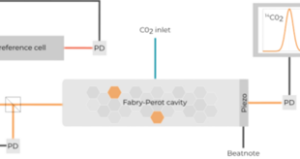
The laser beam travels an effective path length of several kilometers through multiple scans; only in this way can the few CO₂ molecules containing 14C can be detected among the much more abundant molecules containing 12C.
2° CASE – GASEOUS SAMPLE
If the goal is to determine the biogenic fraction of the CO₂ emitted through the stacks of incineration plants, cement plants, or steel plants following waste combustion, the CO₂ must be purified and concentrated before being introduced into the 14C SCAR detector.
Stack emissions need to be purified due to their composition:
➢ fine particulate matter
➢ nitrogen oxides
➢ hydrochloric acid
➢ hydrofluoric acid
➢ heavy metals
etc.
Following the necessary purification steps, a fraction of the emitted CO2 is sampled and injected into our purification and concentration unit: the 8070 Air CO2. Based on a patent, 8070 Air CO2 is a concentrator and purifier of CO2 contained in atmospheric air. Therefore, through its use, it is possible to obtain purified CO2 and introduce it into mass detectors to determine the isotopic ratio δ13C or quantify the content of 14C, a radioactive isotope of carbon. This unit is based on the production of a high volume of pure CO2 according to the principle of adsorption/desorption, with an innovative purification line that allows the elimination of water, VOC and NOx, leaving only pure CO2. So, the purified CO2 will be injected into the 14C SCAR for a complete automatic analysis of the biogenic fraction of the gas. For more information about 14C analysis of CO2 in air, see the Application Note: Biogenic CO2 in atmospheric air.
Conclusions
The elemental and the radiocarbon analysis are powerful tools for the solid waste characterization, not only in term of basic chemical information about the CHN concentration, but to distinguish the biogenic fraction to the fossil one also. This bring highly value to the energy-intensive industries.

