

Listed the podcast
The Greenhouse Gas (GHG)
Scientific evidence and economic statistics indicate that increases in the abundance of atmospheric greenhouse gases (GHGs) since the Industrial Revolution are the result of human activities, either directly or indirectly. Furthermore, the convergence of extensive scientific evidence indicates that increases in long-lived, well-mixed GHG, particularly CO2, CH4, nitrous oxide (N2O), are the main cause for increases in global temperature over the industrial period.
Increasing of CO2
There are both natural and human sources of carbon dioxide emissions. Natural sources include decomposition, ocean release and respiration. Human sources come from activities like cement and steel production, deforestation, waste incineration plants as well as the burning of fossil fuels like coal, oil and natural gas. Due to human activities, the atmospheric concentration of carbon dioxide has been rising extensively since the Industrial Revolution and has now reached dangerous levels not seen in the last 3 million years. Human sources of carbon dioxide emissions are much smaller than natural emissions but they have upset the natural balance that existed for many thousands of years before the influence of humans. This is because natural sinks remove around the same quantity of carbon dioxide from the atmosphere than are produced by natural sources. This had kept carbon dioxide levels balanced and in a safe range. But human sources of emissions have upset the natural balance by adding extra carbon dioxide to the atmosphere without removing any.
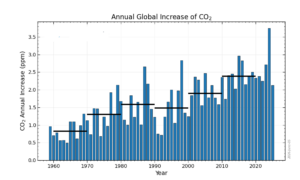 Annual mean carbon dioxide growth rates based on globally averaged marine surface data. Data by The Global Monitoring Laboratory (GML) of the National Oceanic and Atmospheric Administration (NOAA)
Fossil CO2 emission sources
Animals – including humans – breathe out CO2 in the process of respiration. When plants and animals die, their stored carbon is also released as CO2. Natural processes such as respiration and decay, forest fires and volcanic eruptions add an additional 190.2 billion tonnes of CO2 to the atmosphere per year. Excess carbon dioxide emitted by human activity is impacting the natural carbon cycle in the environment that has occurred for millions of years. Humans generate CO2 when burning fossil fuels such as gas, petrol, oil, and coal. This adds an additional 9.1 billion tonnes of CO₂ to the atmosphere each year. Plants and soils take up 2.8 billion tonnes of this extra carbon, while the oceans take up 2.2 billion tonnes. The remaining 4.1 billion tonnes of CO2 stays in the air, increasing the atmospheric concentration of CO2. About 90% of the world’s carbon emissions comes from the burning of fossil fuels – mainly for electricity, heat and transport. In 2022, most of the world’s fossil fuel carbon emissions came from coal (40%), oil (32%), natural gas (21%), cement (5%) and flaring and other smaller sources (2%). Just four regions accounted for about two-thirds of global fossil-fuel carbon emissions in 2021: China (31%), the USA (14%), the EU27 (7%), and India (7%).
Biogenic CO2
When we talk about carbon dioxide (CO2), it’s easy to think of it as a single problem: a greenhouse gas driving climate change. But not all CO2 is created equal. Its source, biogenic or fossil, makes a huge difference in how it impacts the environment, our climate targets, and the sustainability of industrial processes. Biogenic CO2 comes from natural, short-term carbon cycles. It’s produced when organic materials, like plants, crops, or biomass, decompose or are combusted. Biogenic CO2 in atmospheric air refers to carbon dioxide released by biological sources, such as plant respiration, decomposition, and organic combustion. Because this CO2 was recently sequestered from the air via photosynthesis, it is considered part of the natural, short-term carbon cycle and does not add new net carbon to the atmosphere.
The distinction between biological and fossil CO2 is critical for climate accounting and mitigation strategies:
- The Natural Carbon Cycle: plants and trees absorb atmospheric CO2 through photosynthesis to grow. When these plants decompose, are consumed, or are burned as biofuels, they release that exact same CO2 back into the atmosphere. This creates a continuous, circular biological loop rather than introducing new carbon into the environment.
- Carbon Neutrality: because it relies on recently captured carbon, biogenic CO2 is often treated as net-zero under the Greenhouse Gas Protocol and is exempt from many industrial trading frameworks like the European Union Emissions Trading System.
- Distinguishing Sources: scientists use radiocarbon (14C) dating to measure atmospheric samples. Fossil fuels have been trapped underground for millions of years and contain no radiocarbon, whereas biogenic CO2 reflects current atmospheric radiocarbon levels, allowing researchers to accurately separate the two types of emissions
- Applications: biogenic CO2 is increasingly captured from organic waste and biomass processing, then combined with green hydrogen to synthesize renewable e-fuels and materials, offering a zero-greenhouse-gas-intensity alternative to fossil sources
How to measure biogenic fraction of CO2
When biomass is used as a fuel, carbon stored in renewable organic material is released into the atmosphere. It is captured back into the natural carbon cycle as the biomass regrows. Burning a mixture of biomass and fossil fuel can significantly reduce fossil fuel consumption and lower the total carbon footprint. When the two fuels are burned together, an accurate breakdown of what fraction of the emissions are biogenic CO2 can be achieved using the process of radiocarbon dating. This is possible because biogenic CO2 emissions contain carbon-14 isotopes and fossil fuel CO2 emissions do not.
Practical implications of studying the biogenic fraction of CO2
The determination of the biogenic fraction of atmospheric CO2 is of fundamental importance for assessing air quality and monitoring its temporal evolution. However, although such investigations have traditionally been confined to the research community, they are not the only applications of scientific and practical relevance. Indeed, the determination of the biogenic CO2 fraction also has significant implications for a range of real-world applications beyond air quality studies. Companies with large amounts of emissions arising from partly biogenic materials can greatly benefit by differentiating the fraction that is attributable to biogenic versus fossil CO2.
The benefits include:
➢ capitalising on potential surplus allowances gained from more precise quantification of fossil CO2;
➢ subtracting biogenic emissions results in lower annual emissions for reporting and potentially generates surplus allowances for trading;
➢ separate determination of biogenic and fossil CO2 emissions helps organisations quantify their true GHG inventory; and
➢ accurate accounting of fossil CO2 emissions means that organisations know the correct amount of credits needed to offset their carbon footprint over a certain period.
The biogenic radiocarbon testing
Due to the many uncertainty factors associated with mixed-fuel sampling and analysis, radiocarbon dating is recognised as a much more accurate and cost-effective way to determine biogenic CO2.
It also:
✓ allows for fast and easy sample extraction or installation of monitoring equipment
✓ turns around results quickly
✓ accepted under EU Emissions Trading Scheme (ETS), California Air Resources Board (CARB), the US/ Canadian Western Climate Initiative (WCI) and the Australian National Greenhouse and Energy Reporting (NGER) Program.
Anthropogenic CO2 emissions from fossil fuels play an important role in the environmental pollution. Measurements of the radioactive carbon isotope 14C in CO2 are the only quantitative observational means to decipher the fossil fuel CO2 component in the atmosphere. This is because CO2 from burning of fossil fuels, due to the large age of coal, oil and gas of several hundred million years, is free of 14C. Adding fossil fuel CO2 to the atmosphere, therefore, not only leads to an increase of its mixing ratio but also to a decrease of the 14C/C ratio in atmospheric CO2.
A new and completely automatic 14C analysis method
The 14C SCAR (Saturated-absorption CAvity Ring-down) spectrometer is a new and innovative spectrometer for the 14C measure. Developed by a team of the Italian National Research Counsil, it is able to measure the mole fraction of radiocarbon in any sample using the SCAR technique, which improves the CRD (cavity ring down) limits by more than an order of magnitude.
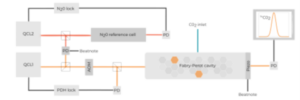 Schematic of the optical and optoelectronic setup of the radiocarbon detection part of C14- SCAR.
In the opto-electronic setup, two Quantum Cascade Lasers (QCLs) are used as laser sources. The QCL2 is frequency-locked to the transition of the N2O molecule, the laser thus locked to the molecular line, via direct spectroscopy, is used as an absolute reference for the frequency scanning. The QCL1 is tuned, thanks to the Pound-Drever-Hall locking (PDH) technique, to the resonant cavity (Fabry-Perot cavity) and the laser used to perform the SCAR spectroscopy of the transition of 14C 16O2. A further frequency-locking occurs between the beat note of the two QCLs, fixing the frequency of the QCL1 to the reference one (QCL2).
Not only 14C SCAR
For this specific application, the 14C SCAR detector was coupled to a sampling unit capable of collecting ambient air, removing all gases except CO2, and concentrating the CO2 prior to analysis.
8070 Air CO2 is a concentrator and purifier of CO2 contained in atmospheric air. Therefore, through its use, it is possible to obtain purified CO2 and introduce it into mass detectors to determine the isotopic ratio δ13C or quantify the content of 14C, a radioactive isotope of carbon.
This unit is based on the production of a high volume of pure CO2 according to the principle of adsorption/desorption, with an innovative purification line that allows the elimination of water, VOC and NOx, leaving only pure CO2.
With the new C-Quantum CO2 absorption system, a large amount of carbon dioxide can be treated with an automatic regeneration system, achieving more precise results and higher performance than other systems. The 8070 Air CO2 is particularly suitable for connection to other units to determine the isotope ratios of stable carbon isotopes or radiogenic 14C in a fully automatic way.
The integration of the 8070 Air CO2 system with the 14C SCAR detector enabled fully automated atmospheric air sampling, eliminating the need for cryogenic processing.

