

Listen the podcast
Introduction
International transportation relies heavily on the global aviation sector to link people, cultures, and economies over great distances. The aviation industry plays a vital role in worldwide tourism and trade, which drives economic growth and globalization. However, significant environmental issues are associated with this vast air transport network.
The aviation sector contributes significantly to greenhouse gases (GHG), which raises pollution levels.
A possible way to lessen the adverse effects of aviation on the environment is to use Sustainable Aviation Fuels (SAF).
The aviation industry’s net-zero carbon emissions target is focused on delivering maximum reduction in emissions at source, through the use of Sustainable Aviation Fuels (SAF), innovative new propulsion technologies, and other efficiency improvements (such as improvements to air traffic navigation).
What is SAF?
SAFs are liquid fuels currently used in commercial aviation, which can reduce CO2 emissions by up to 80%.
SAF contain the same hydrocarbons as fossil-based jet fuel, resulting in similar tailpipe emissions.
However, the key difference is that these hydrocarbons are derived from more sustainable sources.
SAF can be produced from a number of sources (feedstock) including waste fats, oils and greases, municipal solid waste, agricultural and forestry residues, wet wastes, as well as non-food crops cultivated on marginal land.
They can also be produced synthetically via a process that captures carbon directly from the air. SAFs can be considered ‘sustainable’, as their feedstocks do not compete with food crops or output, nor require incremental resource usage such as water or land clearing, and more broadly, do not promote environmental challenges such as deforestation, soil productivity loss or biodiversity loss.
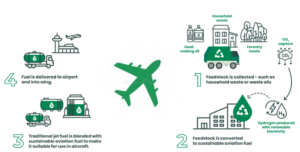
In the quest for environmental sustainability, the European aviation industry stands at a pivotal crossroads. The implementation of Sustainable Aviation Fuels (SAF) has emerged as a cornerstone in the European Union’s strategy to reduce the aviation sector’s carbon footprint. As the world grapples with the urgent need to combat climate change, SAF presents a promising path forward, offering a greener alternative to traditional jet fuels.
The majority of the feedstock for SAF is expected to come from used cooking oils, animal fats, waste oils, and sustainable biomass. More than 60% of the European SAF supply in 2030 is estimated to be covered by HEFA (Hydroprocessed Esters and Fatty Acids) and Alcohol-to-Jet pathway fuels.
Blending fuels
SAF’s chemical and physical characteristics are closely related to those of CAF (Conventional Aviation Fuel). SAF can be mixed with CAF and once blended, certified to the same standard as conventional jet fuel.
This allows the use of the same supply infrastructure and does not require any adaptation of aircraft or engines.
Fuels with these properties are called “drop-in fuels” (i.e., fuels that can be directly incorporated into existing airport fueling systems and onboard aircraft).
CAF is defined as:
aviation turbine fuels (Jet A, Jet A-1, Jet B) and aviation gasoline (AVGAS) derived exclusively from petroleum sources. These fuels are produced through the refining of crude oil, natural gas liquid condensates, heavy oil, oil shale, or oil sands. They are standard hydrocarbon fuels, typically mixtures of 8 to 16 carbon atom molecules.
Therefore, to reduce CO₂ emissions, CAFs are blended with SAFs to obtain a mixture of more environmentally friendly fuels with chemical and physical properties suitable for use in commercial aircraft.
Jet fuel blending primarily involves mixing conventional Jet A/A-1 with Sustainable Aviation Fuels (SAF) to meet strict ASTM D7566 standards, usually up to a 50% blend ratio.
This process, done at storage terminals, ensures compatibility with existing engines while reducing carbon emissions, with additives added for performance.
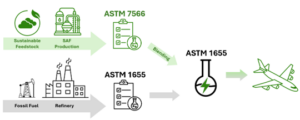
ASTM 7566 is the “Standard Specification for Aviation Turbine Fuel Containing Synthesized Hydrocarbons” and this is the standard to determine if a new fuel derived from a non-fossil source is a candidate jet fuel. This is the first test for certifying a new SAF pathway. Today there are seven approved pathways for SAF.
Once certified under ASTM 7566, a fuel is blended with conventional fossil jet fuel and further tested to the ASTM 1655 performance standard.
If the blended fuel meets that standard, it is then certified as compliant and is considered jet fuel.
That fuel can be distributed through the existing fuel supply infrastructure, including storage, pipelines, and refueling systems at airports, and aircraft can use it without any modifications to engines or fuel systems, as the blended fuel performs like conventional jet fuel.
This result is called a “drop-in” fuel, as it can be dropped into any fuel tank that requires jet fuel.
How much non-fossil fuel does your blend contain?
One of the most accurate ways to study a material’s bio-based vs. petroleum-based composition is to analyze the carbon in the product.
Bio-based carbon originating from plants is radioactive, whereas carbon originating from fossils no longer is.
The amount of radioactive carbon in the sample can thus be used to determine the amount of bio-based content in the material.
The content of radioactive carbon in the organic material can be determined using a dedicated analytical instrument by measuring the 14C carbon isotope in the sample. This method is commonly used to assess the age of organic material, but it can also be used to evaluate how much of the carbon in the material originates from renewable biomass and how much from fossil origin.
By measuring the presence of carbon-14 (or radiocarbon), we can determine the fraction of the sample that is biogenic compared to the fossil fraction, and thus the ratio between CAF and SAF in the blend.
14C isotope analysis
The detection of 14C is really challenging, due to its extremely low concentration in nature: the required sensitivity is of 1 part in 1015
Nowadays, there are three main analytical methods capable of achieving the required sensitivity:
- Accelerator Mass Spectrometry (AMS)
- Liquid Scintillation Counting (LSC).
- Saturated-absorption CAvity Ring-down (14C SCAR)
Our 14C SCAR is the most innovative technique to detect 14C today on the market.
It is:
- completely automated
- suitable for several applications
- superb sensitivity performances
- very compact size
It can be coupled to an elemental analyser for liquid and solid samples analysis, to our 8070 AIR CO2 for atmospheric air analysis and to IRMS for stable isotope analysis also.

